Virtual Chamber Series
→
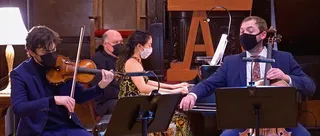
Join us Sunday, April 11 at 4 PM for the second in our series of virtual concerts with distinguished Symphony in C alumni Benjamin Beilman, Janice Carissa, Milena Pajaro-van de Stadt, and Brook Speltz.
This concert has been made available to Symphony in C's patrons and recorded by and for The Jupiter Symphony Chamber Players. We thank them for sharing this concert with us for broadcast on April 11, 2021. The concert will remain on our YouTube channel for one week through April 18, 2021
Louis Spohr: Duo in E minor, Op. 13 (1808) for violin and viola
Benjamin Beilman, violin
Milena Pajaro-van de Stadt, viola
Beethoven: Piano Trio in D Major “Ghost” Op. 70, No. 1 (1808)
Janice Carissa, piano
Benjamin Beilman, violin
Brook Speltz, cello
Harry Munz, audio engineer
Marc Basch, videographer
Pre-Concert Conversation
Join Benjamin, Janice and Brook for a pre-concert ZOOM conversation on March 14th at 3:30 PM.
*Milena regrets that she will not be able to join us as she will be recording with the Dover Quartet at the exact same time.
CLICK HERE FOR PRE-CONCERT CONVERSATION
Watch Concert Here
Symphony in C's YouTube Channel
Program Notes
Louis SPOHR Duo in E minor Op. 13 ▪ 1808
violin & viola
Allegro moderato • Adagio • Tempo di minuetto
Grand in eloquence and virtuosity, the Duo for violin and viola was composed in his 24th year.
Spohr was a dominant force in German music and as famous as Beethoven—he served in a number of court positions, he was the celebrated leading violin virtuoso, he was one of the most sought-after and prolific composers of the first half of the 19th century, and is considered a forerunner of early Romanticism. He was also an ideas man—he invented the chin rest, introduced the use of the baton and rehearsal numbers, developed the double quartet after Andreas Romberg first proposed the idea, and revived the music of Bach and Handel. In addition to his musical activities, he was a family man who enjoyed a happy social
life and varied pursuits like swimming, ice-skating, hiking, gardening, and painting.
BEETHOVEN Piano Trio in D Major “Ghost” Op. 70 No. 1 ▪ 1808
violin, cello, and piano
Allegro vivace e con brio • Largo assai ed espressivo • Presto
Famous for its highly original dark and mysterious Largo movement, thus named “Ghost” by his pupil Carl Czerny because it reminded him of Hamlet’s ghost.
Beethoven’s own notes reveal that he was sketching an opera about Macbeth at the time! The Belgian musicologist Harry Halbreich states that “this is one of the first atmospheric ‘mood-pieces’ in music history, where elements of tone-color tend to blur the formal outline.The dark gloom of this Largo, which stands in such striking contrast to the brightness of the outer movements, is further enhanced by the frequent low rumblings on the piano.”
In 1808, Spohr rehearsed the “Ghost” with Beethoven at the latter’s home. He recounted that the piano was out of tune and that Beethoven’s playing was “harsh or careless.” The two men were friends, and Spohr admired Beethoven’s music, especially the early string quartets, which he usually played in most of his chamber concerts until the end of his performing career in 1858. Although Spohr did not understand or appreciate Beethoven’s later works he felt it his duty to promote his music by conducting it in orchestral concerts.