Virtual Chamber Series
→
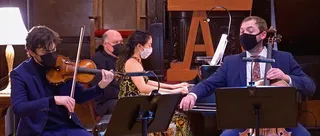
Join us Sunday, April 11 at 4 PM for the second in our series of virtual concerts with distinguished Symphony in C alumni Benjamin Beilman, Janice Carissa, Milena Pajaro-van de Stadt, and Brook Speltz.
Louis Spohr: Duo in E minor, Op. 13 (1808) for violin and viola
Benjamin Beilman, violin
Milena Pajaro-van de Stadt, viola
Beethoven: Piano Trio in D Major “Ghost” Op. 70, No. 1 (1808)
Janice Carissa, piano
Benjamin Beilman, violin
Brook Speltz, cello
Harry Munz, audio engineer
Marc Basch, videographer
ABOUT THE ARTIST
Pre-Concert Conversation
Join Christine and Sae Hashimoto for a pre-concert ZOOM conversation on March 14th at 3:30 PM.
CLICK HERE FOR PRE-CONCERT CONVERSATION
Watch Concert Here
CLICK HERE to watch the concert on March 14th at 4 PM
About the Concert
Novotney: A Minute of News for solo snare drum
A Minute of News is a snare drum solo written by American composer Eugene Novotney in 1990. In this piece, the performer explores a wide array of different techniques and devices on a single drum to produce a mesmerizing groove that is fun to watch and listen to.
J.S. Bach: Sonata No. 1 in G minor, BWV 1001
I. Adagio IV. Presto
All of the solo violin sonatas by J.S Bach follow the precedent of the “church sonata,” which is derived from the influential master of this style Arcangelo Corelli. The sonatas follow the standard four movement disposition of sonata da chiesa—slow-fast-slow-fast. While we will only be hearing essentially half of the first sonata in this virtual concert, we will hear the famous Adagio movement which features such solemn and lamenting chromaticism throughout. Although it sounds like the ornaments may be at the discretion of the performer, they are firmly and meticulously written out by Bach himself. The performance will end with the Moto perpetuo Presto movement where you will hear the two-part dance form and a lilting Siciliana.
A. Piazzolla: Histoire du Tango
I. Bordello, 1900
II. Cafe, 1930
III. Night Club, 1960
IV. Modern-Day Concert
In Piazzolla’s duo masterpiece the Histoire du Tango, he manages to paint four vivid tango landscapes beginning with a fast and lively movement in the style of the first tangos that would have been heard in the bordellos of Buenos Aires as early as 1882. This is followed by a much more melancholic tango that seems more like people would watch a tango orchestra perform at a cafe rather than dance to it. By the time we reach the night club, one can clearly hear the boisterous Brazilian Bossa nova infusion that brought Piazzolla to fame. In the final movement, the tango has found its way to the acclaimed concert halls around the world where influences of Stravinsky and Bartok can be heard.
About the Composers
Eugene Novotney (1960 - )
As a percussionist and composer, Eugene Novotney has performed and presented lectures and master classes in North America, South America, the Caribbean, Europe, Asia, and Africa. Recognized internationally as a composer of contemporary percussion music, his compositions are widely performed as standards of the literature. His snare drum composition, A Minute of News (The Noble Snare), has been used as the test piece for numerous snare drum competitions, including the Concours International de Caisse Claire - Conservatoire National de Region de Paris (2004 and 2007 Paris, France); the VIII Jornadas Internacionales de Percussion de Ribarroja del Turia (2006 Valencia, Spain); the Atlanta Symphony Orchestra Modern Snare Drum Competition (2008 Atlanta, Georgia); the Concorso Internazionale per Strumenti a Percussione e Batteria (2009 Fermo, Italy); and others.
Dr. Novotney has also conducted research trips to Xian, Shanghai & Beijing, China, Ubud, and Blabatuh, Bali, Accra, and Kokrobite, Ghana, Rio de Janeiro, Brazil, and Port-of-Spain, Trinidad, resulting in numerous transcriptions, arrangements, and analytical studies. He has performed on several occasions in Trinidad’s National Panorama Competition, and he has regularly served as an adjudicator for Pan Trinbago, the national governing body for the advancement of steel Band music in Trinidad & Tobago. He was a member of the adjudication panel of Trinidad’s World Steel Band Festivals in 1998, 2000, and 2008 held in Port-of- Spain, Trinidad, and served as an adjudicator for Trinidad’s World Steel Band Festival 2005, held in Madison Square Garden, New York, NY. In addition, he was a member of the adjudication panel of the 2000 European Steel Band Festival held in Paris, France, and the adjudication panel for the 2005 Trinidad National Schools Music Festival held in Port-of-Spain.
He is Professor of Music and Director of Percussion Studies at California State University-Humboldt, and is the founder and coordinator of the ‘Percussion in World Music’ program for the California State University Summer Arts Program. In 2006, Dr. Novotney was awarded the Wang Family Excellence Award by the California State University Board of Trustees, a prestigious award that recognizes and celebrates California State faculty who, through extraordinary commitment and dedication, have distinguished themselves through exemplary contributions and achievements in their academic disciplines. Eugene Novotney currently serves as a member of the Board of Directors of the Percussive Arts Society, and also, as the Chairman of the Percussive Arts Society New Music/Research Committee. His recordings have been released on the Bembe, Delos, SANCH, Pogo, Rituals and Earthbeat (Rhino) labels, and his compositions are available through Smith Publications of Baltimore, Maryland. Humbolt State University
Johann Sebastian Bach (1685-1750)
Born into a musical family, Bach received his earliest instruction from his father. After his father's death in 1695, Bach moved to Ohrdruf, where he lived and studied organ with his older brother Johann Christoph. He also received an education at schools in Eisenach, Ohrdruf, and Lüneburg. Bach's first permanent positions were as organist in Arnstadt (1703-1707) and Mühlhausen (1707-1708). During these years, he performed, composed taught, and developed an interest in organ building. From 1708-1717 he was employed by Duke Wilhelm Ernst of Weimar, first as court organist, and after 1714, as concertmaster. During this period, he composed many of his best organ compositions; in his capacity as concertmaster, he was also expected to produce a cantata each month. In Weimar, Bach's style was influenced by his study of numerous Italian compositions (especially Vivaldi concertos).
Bach's next position, as Music Director for the Prince Leopold of Cüthen (1717-1723), involved entirely different activities. Since the court chapel was Calvinist, there was no need for church compositions; Bach probably used the Cüthen organs only for teaching and practice. His new works were primarily for instrumental solo or ensemble, to be used as court entertainment or for instruction. Among the important compositions at Cüthen were the Brandenburg Concertos, the first volume of Das wohltemperirte Clavier (The Well-Tempered Clavier), the "French" and "English" Suites for harpsichord (although the "English" Suites may be from the Weimar period), and most of the sonatas and suites for other instruments. Bach also composed a few cantatas for special occasions (birthdays and New Years).
In 1723, Bach was appointed cantor at the St. Thomas Church and School, and Director of Music for Leipzig, positions which he retained for the rest of his career. His official duties included the reponsibility of overseeing the music in the four principal churches of the city, and organizing other musical events sponsored by the municipal council. For these performances, he used pupils from the St. Thomas School, the city's professional musicians, and university students. Bach divided his singers into four choirs (one for each of the four main churches); he personally conducted the first choir, which sang on alternate Sundays at St. Thomas and St. Nicholas. His usual performing group consisted of around sixteen singers and eighteen instrumentalists, although these numbers could be augmented for special occasions. During his first six years in Leipzig (1723-1729), Bach's most impressive compositions were his sacred cantatas (four yearly cycles), and the St. John and St. Matthew Passions. Bach apparently gave virtuoso organ recitals in Leipzig and on various tours, although he had no official position as organist in Leipzig.
After 1729 Bach no longer concentrated so completely on composing sacred vocal music. For services, he re-used his own substantial repertory of cantatas, and turned increasingly to the music of his contemporaries. In 1729-1737 and 1739-1741, he was director of the Leipzig Collegium Musicum, an organization that had been founded by Telemann in 1704. This group of professional musicians and university students performed weekly concerts (out-of-doors in the summer, and at Zimmerman's coffee- house in the winter). Although no specific programs for these concerts have survived, Bach apparently revived and many of his instrumental compositions from Cüthen, wrote new works (e.g., secular cantatas), and conducted pieces by other composers. During the 1730s, Bach renewed his interest in keyboard compositions, and prepared the first three volumes of his Clavier-Übung (Keyboard Practice) for publication (1731, 1735, 1739); the fourth volume appeared in 1741-1742. In the 1730s, he also showed considerable interest in the royal court at Dresden, and was named "Hofkomponist" (court-composer") in Dresden in 1736.
During Bach's last decade (the 1740s), he completed or revised several large-scale projects which he had started earlier. The Well-Tempered Clavier, Vol. II; a manuscript collection of chorale preludes (known as the "Leipzig 18", comprising revisions of Weimar pieces), and the B minor Mass. Other new works showed an increased interest in fugal and canonic writing: Musikalische Opfer (Musical Offering); the canonic variations for organ on "Vom Himmel hoch"; and Die Kunst der Fuge ( The Art of Fugue). In the 1740s, Bach made various journeys, most notably to the court of Frederick the Great in 1747. He continued a lively interest in the building of organs, and kept informed about the latest developments in the construction of harpsichords and pianofortes. Bachcentral.com
Astor Pantaleón Piazzolla (1921 - 1992)
Astor Piazzolla was an Argentine musician, a virtuoso on the bandoneón (a square-built button accordion), who left traditional Latin American tango bands in 1955 to create a new tango that blended elements of jazz and classical music. He was a major Latin American composer of the 20th century.
In 1925 Piazzolla moved with his parents to New York, where the family lived until 1936. He received his first bandoneón at age eight and learned to play both that instrument and the piano as a child. When the family returned to Mar del Plata in 1936, Piazzolla began playing with a variety of tango orchestras. At age 17, he moved to Buenos Aires. He formed his own orchestra in 1946, composing new works and experimenting with the sound and structure of the tango. About the same time, he began to compose music for film. In 1949, he disbanded the orchestra, unsatisfied with his own efforts and still interested in classical composition. Having won a composing contest with his symphonic piece Buenos Aires (1951), he went to study in Paris with Nadia Boulanger. She urged him to remain true to himself and to continue his experiments with the tango. Henceforth he combined his two musical passions, despite much criticism from tango traditionalists. He returned to Argentina in 1955 but moved once again to the United States, where he lived from 1958 to 1960. When he returned to Argentina, he formed the influential Quinteto Nuevo Tango (1960), featuring a violin, electric guitar, piano, double bass, and bandoneón. Though he wrote many of his 750 compositions for that quintet, he also composed pieces for orchestra, big band, bandoneón, and cello. His innovations, including counterpoint and new rhythms and harmonies, were greatly admired in the United States and Europe. He moved to Paris in 1974 but returned to Argentina in 1985. In Argentina, Piazzolla’s new tango gradually gained acceptance, and his music influenced a new generation of tango composers and was featured during the 1970s and ’80s in film scores, television programs, and commercials. His later compositions included a concerto for bandoneón and orchestra (1979) and, commissioned by Kronos Quartet, Five Tango Sensations for bandoneón and string quartet (1989). EncyclopediaBrittanica.com