(Cancelled) Strauss & Poulenc
Saturday, February 21, 2026 at 7:30 pmSunday, February 22, 2026 at 3PM
**Due to impending winter weather, Sunday's performance has been cancelled for the safety of our patrons and musicians. All Sunday ticket holders will be refunded, and we look forward to seeing you at a future performance.**
We heard you—and we’re making it easier to join us. ❤️
Strauss & Poulenc is now a TWO-CONCERT weekend (same venue, same program)!
A vibrant program that moves from noble elegance to playful with Johannes Brahms’s
Variations on a Theme of Joseph Haydn opens with richly crafted variations full of warmth and grandeur. Richard Strauss’s Oboe Concerto follows-lyrical, graceful, and conversational, showcasing the oboe’s expressive voice. The concert concludes with Francis Poulenc’s sparkling Sinfonietta, a spirited work brimming with charm, color, and French flair.
Brahms: Variations on a Theme of Joseph Haydn, op. 56a
R. Strauss: Oboe Concerto, TrV 292
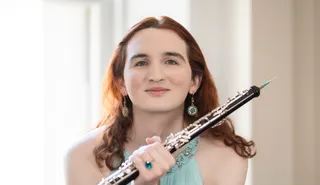
Ben Price, oboe
Poulenc: Sinfonietta
Program: 75 minutes of music plus a 15 minute intermission
Pre-concert talk: offered on Saturday evening only from 6-6:30 pm
Dress: business casual
Concessions: not available, please bring a small bottle of water with you.
GET YOUR TICKETS BELOW:
PROGRAM NOTES:
Johannes Brahms
Born: May 7, 1833, in Hamburg, Germany
Died: April 3, 1897, in Vienna, Austria
Variations on a Theme of Joseph Haydn, op. 56a
Maybe it’s the portrait that typically appears in music books, or maybe it’s
the downcast, minor-key character of several of his major works, but
Brahms is often thought of as serious, even grave. This mid-career work,
one of his first for full orchestra, suggests a witty, playful side to Brahms.
Every piece of theme-and-variations, as heard in Rachmaninoff’s
Rhapsody on a Theme of Paganini earlier this season, gives a composer
free rein to alter and reshape a melody; sometimes each successive
variation tries to top the previous one. In reshaping the “Chorale St.
Anthony,” found in Christian hymnals over the decades, Brahms takes an
approach that’s more subtle than showy. Though there’s some doubt that
Haydn himself wrote the original melody, Brahms pays tribute to one of his
great Germanic forbears, whose prolific output established both the string
quartet and symphony as staples of concert music.
Even amid the stately original theme, there’s some slightly irregular
phrasing and ear-catching touches of chromatic movement. Brahms
maintains a bit of that character even as he takes bits of the original
chorale into more harmonically distant keys and each successive variation
grows more inventive. The dotted rhythms and light touches of
chromaticism are still present, though passages in the later variations have
a slippery sense of rhythm, with contrasting lines in duple and triple meters
sliding past one another.
Brahms keeps the dynamic arc and forward-pressing sense of rhythm from
the original while stretching it into different shapes. Those shapes can turn
dramatic, like the minor-key second variation; humorously overwrought,
as in the sixth variation, with brassy pomp from the French horns; or lilting,
like the seventh, with wave after wave of overlapping melodies anchored
by the weight of the horns and lower strings.
The final variation compresses almost an entire symphony’s worth of
variability into just a few minutes. Hushed and skittering at first, it
undergoes numerous rhythmic shifts as it builds toward a bold, marcato
declamation of the melody, set against rapid scales in the strings and
woodwinds, before a rousing, major-key close.
Variations on a Theme of Joseph Haydn is scored for flutes (2nd doubling
piccolo), oboes, clarinets, bassoons, contrabassoon, horns, trumpets,
timpani, percussion and strings.
Richard Strauss
Born: June 11, 1864, in Munich, Bavaria
Died: September 8, 1949, in Garmisch-Partenkirchen, West
Germany
Concerto in D Major for Oboe and Small Orchestra, TrV 292
Strauss’ Oboe Concerto is grouped among the composer’s “late works,”
written alongside the opera Der Rosenkavalier, the Second Horn Concerto
and the Four Last Songs. Across genres, late works carry added weight
beyond coming late in an artist’s life: the music and cultural Edward Said
wrote about “late style” manifesting as an artist feeling unconstrained by
the current style of their age. Works composed in a “late style” can often
be anachronistic or backward-looking, possibly out of step with the times
or out of character from the artist’s earlier works.
With this in mind, the opening — a tidy, sixteenth-note gesture in the
strings — makes it clear we’re in a totally different sound world from the
lush tone poems and operatic scores Strauss wrote for large orchestra.
Muted strings provide light accompaniment for agile, singing lines from the
soloist, with plentiful moments for the orchestra woodwinds to shine in
duets with, or in contrast to, the soloist. As the soloist unfurls line after line
of cascading sixteenth notes over Mozart-like cadences, the piece takes
on a luminous yet antique quality. Premiered in 1946 and composed amid
the violent end of World War II and tumultuous post-war period, the
Concerto sounds as though it could have been written a century earlier.
The second movement starts out stately and unhurried, with the soloist
sharing the spotlight with solo clarinet, sometimes joined by the first violins
in unison. After some broad, warm tutti chords, the textures thin out and
give the impression of heading toward a quiet close. It’s a clever evasion,
though, giving way to an oboe soliloquy over light pizzicato
accompaniment in the strings. Rapidly fluttering figures from the soloist
launch the ensemble forward into the third movement, where oboe and
ensemble trade off playing upward-pointing figures then swooping back
down.
Listen for a moment about halfway through that breaks out of this back-
and-forth: a lovely duet between the soloist and English horn. Some hazy,
drifting phrases from the soloist introduce a brief cadenza that gives way
to the concluding Allegro. Here the courtly phrases and orchestral swells
once again recall music from an earlier era — Mendelssohn or Beethoven,
perhaps — before a curt, understated ending.
The Concerto for Oboe and Small Orchestra is scored for flutes, English
horn, clarinets, bassoons, horns, strings and solo oboe.
Francois Poulenc
Born: January 7, 1899, in Paris, France
Died: January 30, 1963, in Paris France
Sinfonietta in F Major, FP 141
Poulenc is firmly on the post-Romantic side of the coin of World War II-era
European music — alongside Strauss, of course — in contrast to atonal
works composed in the serial, or twelve-tone, method. This Sinfonietta
was written and premiered around the same time as the Strauss oboe
concerto but utterly different in character.
The overall feel is busy and harmonically restless, but without sacrificing
rich orchestral color and textures lent by lush strings and fluttering
woodwinds. There’s a swooning, almost woozy feeling even at brisk
tempos as the piece pushes forward, with brief solos from trumpet and
horn popping out, and even dissonant passages float along rather than
grind on.
The second movement skitters forward in irregular but upbeat fashion, with
triple meters predominating and spiky textures punctuated by brass. Just
when the music seems in steady motion, marching along a rapid clip,
something destabilizes the mix: Tremolando in the strings, or buzzing
tones from the brass. There’s also a brief moment, just before the end of
the movement, where the tempo slows to half-time, and the orchestra
almost seems to pirouette in place.
When the tempo slows in the third movement, the kaleidoscopic shifts in
harmony become both more apparent and more radiant. Starting with the
opening woodwind chorale, set against pizzicato strings, the textures are
light and diaphanous, with brief glints of dissonance and several lovely,
low-swooping lines in the oboe and clarinet.
The shift back to brisk forward motion in the final movement comes across
as almost comically brusque, although even the louder, heavier-accented
sections have a sense of wry humor rather than angst. The orchestra
continues at a rapid clip even when the dynamics grow hushed, and when
a sudden pause introduces a placid interlude just before the conclusion, a
trumpet bleat and a high-register clarinet honk shock the ensemble back
into motion. From there, the familiar main theme surges back in before a
punchy, brass-led finish.
The Sinfonietta is scored for flutes, oboes, clarinets, bassoons, horns,
trumpets, timpani, harp and strings.
Program notes written by David Allen.