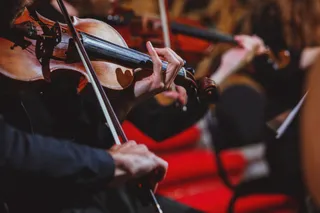
Bruch’s Violin Concerto
→
Saturday, January 13, 2024
8 PM
Jessie Montgomery: Records from a Vanishing City
Bruch: Violin Concerto No. 1, Op. 26, G minor
Soloist: William Hagen, Violin
I. Vorspiel: Allegro moderato
II. Adagio
III. Finale:Allegro energico
Beethoven: Symphony No. 4, Op. 60, B-flat major"
I. Adagio-Allegro vivace
II. Adagio
III. Allegro vivace. Trio
IV. Allegro ma non troppo
PROGRAM NOTES:
Jessie Montgomery
Born: December 8, 1981, NYC
Records from a Vanishing City
The world of classical music has continuously evolved, embracing new voices that
breathe life into the genre with innovative perspectives. Among these voices,
composer and violinist Jessie Montgomery shines brightly, her work contributing to
a dynamic reimagining of classical music. One of her notable compositions,
"Records from a Vanishing City," captures the essence of cultural resilience and
transformation, reflecting both the spirit of a community and the power of music to
tell stories of heritage and change.
"Records from a Vanishing City" was composed in 2016 and is part of a collection
titled "Records from a Vanishing City: String Quartets by Jessie Montgomery." The
piece is a musical reflection on the gentrification and transformation of New York
City's Lower East Side, a historically vibrant neighborhood that has experienced
significant changes over the years. Montgomery's composition uses the string
quartet as her canvas, creating a musical tapestry that weaves together past and
present, celebrating the neighborhood's rich history while also acknowledging the
challenges it faces.
The music itself is a testament to Montgomery's skillful craftsmanship and
innovative approach. Drawing inspiration from a wide array of influences, including
jazz, blues, and folk music, Montgomery blends these elements seamlessly into
her composition. The result is a multi-layered sound that resonates with both the
familiarity of tradition and the excitement of the contemporary. By intertwining
various musical idioms, Montgomery captures the diverse cultural heritage of the
Lower East Side, paying homage to the neighborhood's history while embracing
the spirit of change.
"Records from a Vanishing City" is characterized by its evocative melodies,
intricate harmonies, and rhythmic vitality. The piece opens with a mournful and
introspective theme, perhaps symbolizing the fading echoes of the past. As the
music unfolds, it transitions into more upbeat and rhythmic sections, suggesting
the resilience and vibrancy of a community that continues to thrive amidst
transformation. Through her composition, Montgomery creates a musical narrative
that traverses emotions, mirroring the complex tapestry of the Lower East Side's
identity.
Beyond its musical qualities, "Records from a Vanishing City" serves as a poignant
reminder of the power of art to convey meaningful narratives. By exploring themes
of change, displacement, and cultural heritage, Montgomery's composition
becomes a vessel for conversations about societal issues. It prompts listeners to
reflect on the importance of preserving communities and honoring their histories,
even in the face of modernization and progress. In this way, the music becomes a
catalyst for dialogue and empathy, transcending the boundaries of traditional
concert halls.
Overall, it may be said that Jessie Montgomery's "Records from a Vanishing City"
stands as a testament to the transformative potential of music. Through her
composition, Montgomery paints a vivid portrait of cultural resilience, capturing the
spirit of a neighborhood in flux while celebrating its enduring heritage. The piece's
fusion of diverse musical influences and its exploration of complex themes make
it a compelling example of contemporary classical music that resonates on both
artistic and societal levels. "Records from a Vanishing City" invites us to listen,
learn, and engage with the stories that music can tell, reminding us of the enduring power of creativity to shape our understanding of the world around us.
Max Bruch
Born on January 6, 1838
Died on October 2, 1920
Violin Concerto No. 1 in G minor, Op. 26
The enormous success and enduring popularity of German composer Max Bruch’s
First Violin Concerto has caused it to eclipse most of his other works, of which the
best known are the Scottish Fantasy for violin and orchestra in E flat major, Op. 46
(1880) and Kol Nidrei, for cello and orchestra, Op. 47 (1881). Each year, the British
radio station Classic FM, which also maintains a major web presence, conducts a
Hall of Fame listeners’ poll in which the public can vote for their favorite pieces.
This concerto has been voted consistently to either the top spot or within the top
10 (it sits at number 5 in Classic FM’s all time most popular classical works, behind
Rachmaninov’s Second Piano Concerto and Vaughan Williams’s “The Lark
Ascending,” but ahead of Beethoven’s Ninth Symphony and Pachelbel’s Canon in
D). Even during his lifetime, the concerto’s popularity frustrated Bruch who felt his
other compositions were being neglected. After receiving numerous invitations to
attend performances of the piece, Bruch’s son recounted his father’s exasperation:
“The G-Minor Concerto again! I couldn’t bear to hear it even once more! My friends,
play the Second Concerto, or the Scottish Fantasia for once!” To make matters
worse, Bruch was undercompensated for a work of such popularity since he ill-
advisedly sold the rights to his publisher for a lump sum rather than choosing to
receive regular royalty payments. The decision was unfortunate since he spent his
last years in financial straits.
Bruch was born in Cologne, Germany, in 1838, and, like many professional
musicians, received his earliest musical training at home as a child. His mother
was a singer and under her tuition he learned enough that by the time he was nine
he was composing chamber works. His winning of the Frankfurt Mozart-Stiftung
Prize at age 14 secured him a solid, formal musical education. He held a series of
conducting and teaching positions over the course of his career but lived primarily
in the shadows of Johannes Brahms and Richard Wagner. Like Brahms, Bruch
eschewed both the techniques and the progressive rhetoric of the New German
School of composition, preferring to model his work after Mendelssohn and
Schumann. Consequently, his compositions sounded anachronistic in the mid to
late 19th century music world, which was rapidly moving forward.
It was while Bruch held a music directorship at Koblenz, a city on the Rhine in
Western Germany, that he began work on the Violin Concerto in G minor. The
premiere of the work occurred in April 1866 with Bruch conducting and Otto von
Königslow as the soloist. After this performance, Bruch consulted with the famous
virtuoso Joseph Joachim on a revision of the concerto, which was completed in 1867.
Joachim, to whom Bruch dedicated the published concerto, appeared as
soloist in the debut performance of the revised score, which took place in the North
German city of Bremen on January 5, 1868. Carl Martin Reinthaler, organist at the
Bremen Cathedral and an important figure in the city’s musical life, served as
conductor.
Movement one, Vorspiel: Allegro moderato, follows a sonata-allegro form. The
term vorspiel means “prelude” and its usage in a concerto movement is unusual.
The character of a musical prelude is to sound improvisatory even when
completely composed, like a fantasy. While Romantic composers like Chopin
composed standalone preludes, they are also found linked to other movements,
as in Bach’s Well-Tempered Clavier, or as an overture-like introduction to opera
acts. The concerto’s movement features an abundance of striking melodies, while
balancing sections of mysterious repose with passionate outbursts typical of the
Romantic era. Bruch connects the first two movements without any break.
To many, the second movement, Adagio, is simply one of the most beautiful pieces
of music. Out of the soft connecting passage from the first movement, the soloist
emerges with a bittersweet melody. Bruch uses three musical themes in the
movement that work to evoke a wistful and melancholic, but never overly
sentimental, mood.
The third movement, Finale: Allegro energico, resembles an energetic folk dance,
much like the conclusion of the Violin Concerto in D major by Brahms 10 years
later. Bruch was an admirer of folk melodies and wove them into several of his
compositions, such as his Scottish Fantasy which uses themes from four Scottish
folk songs. After the intensely passionate writing of the Adagio, Bruch emphasizes
the virtuosity of the soloist in this movement, with the ending offering a thrilling
buildup and climax.
The concerto is scored for solo violin along with an orchestra of two flutes, two
oboes, two clarinets, two bassoons, four horns, two trumpets, timpani, and strings.
Ludwig van Beethoven
Born on December 16, 1770, in Bonn, Germany
Died on March 26, 1827, in Vienna, Austria
Symphony No. 4 in B-flat major, Op. 60
Ludwig van Beethoven's Symphony No. 4 in B-flat major, Op. 60, holds a unique
place in the composer's oeuvre by sitting between the genre shattering Eroica
Symphony and the Fifth Symphony, arguably the composer’s most famous work.
Robert Schumann famously described the work as “a slender Greek maiden
between two Norse giants.” The Fourth Symphony was born out of a visit that
Beethoven and his patron, Prince Karl Alois Lichnowsky, made to the house of
Count Franz von Oppersdorff in Oberglogau in September 1806. The Count, who
maintained a private orchestra, honored Beethoven with a performance of his
Second Symphony and subsequently commissioned a new symphony from him.
There are several theories as to why Beethoven chose to compose the Fourth
Symphony instead of completing his Fifth Symphony for Oppersdorff's
commission. Some suggest that the Fourth was essentially complete before
Oppersdorff's offer, while others propose that Beethoven may not have felt ready
to press on with the radical and emotionally demanding Fifth. Yet another theory
suggests that Oppersdorff's evident liking for the more Haydnesque world of the
Second Symphony prompted Beethoven to compose another work in a similar
vein. Despite Oppersdorff having paid for exclusive rights to the work for its first
six months, his orchestra did not give the first performance. The premiere of the
work occurred in March 1807 at a private concert in Vienna at the town house of
Prince Franz Joseph von Lobkowitz, another of Beethoven’s patrons. It then
received its first public performance at the Burgtheater in Vienna in April 1808. The
orchestral parts were published in March 1809, but the full score was not printed
until 1821. The manuscript, which was for a time owned by Felix Mendelssohn, is
now in the Berlin State Library.
The Fourth Symphony is often seen as a descendant of Haydn's symphonies.
Haydn, an enormous influence on Beethoven as a young man, is known as the
“father of the symphony” by giving the genre a new sense of humor and
pictorialism, composing with a virtuosity in his wind and brass parts, and creating
excitement in the string writing. While the Fourth Symphony possesses a formal
balance associated with Haydn’s Classicism, it brims with an athletic vigor,
contemplative rumination, and puckish humor of the early Romantic era. It also
looks forward to Beethoven's Fifth Symphony in some of its compact compositional
processes.
Like most of Haydn’s 12 London Symphonies, the first movement, Adagio - Allegro
vivace, begins with a slow, mysterious introduction, a dramatic feature that
Beethoven exploited throughout his symphonic career. The suspenseful Adagio
gives way to the lively Allegro vivace, presenting a joyful, energetic theme that sets
the tone for the rest of the symphony.
The second movement, Adagio, serves as a lyrical interlude. Its serene, song-like
melody, carried by the strings and woodwinds, provides a stark contrast to the
vigorous first movement. This movement showcases Beethoven's ability to craft
beautiful, emotive melodies, a hallmark of his middle period.
The third movement, Allegro vivace, is a playful scherzo, replacing the traditional
minuet. Its light, buoyant theme, punctuated by robust orchestral tuttis, adds a
touch of humor and whimsy. The trio section, featuring a dialogue between the
winds and strings, further enhances the movement's charm.
The final movement, Allegro ma non troppo, is a spirited rondo, with challenging
parts for the woodwinds. Its recurring main theme, interspersed with contrasting
episodes, creates a sense of joyful culmination. The movement concludes with a
brisk coda, bringing the symphony to a triumphant close.
The symphony is scored for flute, 2 oboes, 2 clarinets, 2 bassoons, 2 horns, 2
trumpets, timpani and strings.
Symphony in C program notes are written by Eric Polack and Joseph C. Schiavo.