Brahms Third Symphony
Experience an inspiring evening featuring the Oberon Overture by Carl Maria von Weber, followed by Violin Concerto, one of the best violin concerto's by an American composer and native son to the Philadelphia area, Samuel Barber. The he night concludes with Brahms' majestic "Symphony No. 3 in F Major, Op. 90." Don’t miss this showcase of emerging talent and timeless classics.
Brahms Third Symphony
Saturday, May 3, 2025 at 7:30 PM
Weber: Oberon Overture
Barber: Violin Concerto
Amaryn Olmeda, violin
Brahms: Symphony No. 3
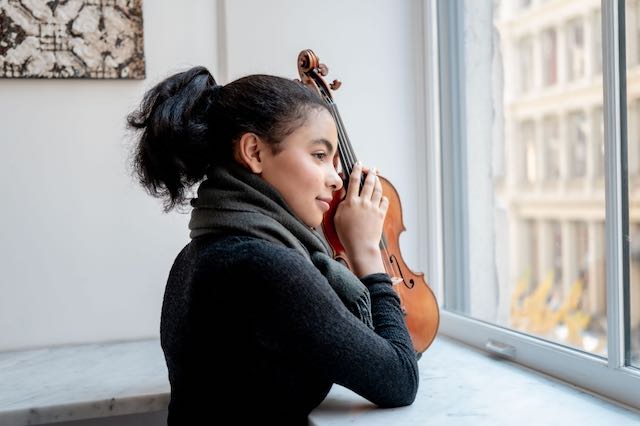
violin
Photo: Marco Borggreve
Program Notes
Johannes Brahms
Born on May 7, 1833, in Hamburg, Germany
Died on April 3, 1897, in Vienna, Austria
Symphony No. 3 in F major, Op. 90
Johannes Brahms was 43 years old when his Symphony No. 1 in C minor received its premiere performance in November 1876. 21 years after his first symphony sketches evolved into his Piano Concerto No. 1, he had finally achieved what many believed to be the symphonic successor to Beethoven’s 9th. His relief was so great that by the following November, he had written and seen the debut of his genial Symphony No. 2 in D major, a work that came much more easily to him. It would be another six years when, at the age of 50, he returned to the symphonic genre and began work on his Symphony No. 3 in F major during the summer of 1883. It is the shortest of Brahms’s four symphonies and is particularly well-crafted even for this normally meticulous composer. For instance, the symphony’s four movements explore the key relationships between the tonic note F and its dominant C in both their major and minor modes, which gives the overall work a loose sonata form. Brahms was at the height of his powers and was firmly established as one of the leading composers of his time. Yet, he was keenly aware of his advancing years. The character of the symphony is one of autumnal reflection. It differs greatly from the turbulence of the first symphony, the sunniness of the second, and the tragic quality of the fourth.
The first movement, Allegro con brio, in the home key of F major, introduces a rising motive based on the notes F, A-flat, and F an octave higher that is used throughout the symphony, giving it a cyclic form. The roots of this motive are in Brahms’s youth when, as a 20-year-old in the fall of 1853, he collaborated on a sonata for violin and piano with Robert Schumann and Albert Dietrich, a student of Schumann. This F–A–E Sonata was written for Joseph Joachim and was based on his personal motto, "Free, but lonely," or, in German, Frei aber einsam. Brahms adopted his own motto in response to Joachim, Frei aber froh, or “Free, but happy.” Brahms uses the F–A-flat–F motive throughout the movement to lend structure and coherence through the various key changes of the developmental section of the movement’s sonata form. The 6/4 meter, which was a favorite of Brahms that he used extensively in his Piano Concerto No. 1, gives the movement a rhythmic flavor uncommon in symphonic opening movements.
The second movement, Andante, is in the key of C major. Whereas the first movement seemingly alternates between the yearning of youth and the rebelliousness of middle age, the second movement possesses a tranquility. The melody of the primary theme is given to the clarinets and bassoons.
The third movement, Poco Allegretto, while in a triple meter, lacks both the lightness of mood and the rhythmic verve typical of third movements. The form of the movement is A-B-A, with the A sections in a somber C minor and the B section in A-flat major, which is closely related to the F minor that opens the next movement.
Much of the final movement, Allegro, is in F minor, though Brahms provides contrasting passages in A-flat major. Rather than marking the return of F major as an apotheosis, like the glorious arrival of C major in both his Symphony No. 1 and in Beethoven’s Symphony No. 5, Brahms chooses to make the return subtle. In fact, the conclusion of the symphony is distinguished by its quietness, as if the composer, who was finally out from the long shadow cast by Beethoven, had accepted his advancing years with grace and satisfaction. The Symphony No. 3 made its debut on December 2, 1883, with the Vienna Philharmonic Orchestra performing under the direction of Hans Richter. Brahms scored the symphony for an orchestra of two flutes, two oboes, two clarinets, two bassoons, a contrabassoon, four horns, two trumpets, three trombones, timpani,
and strings.
©Symphony in C program notes are written by Eric Polack and Joseph C Schiavo