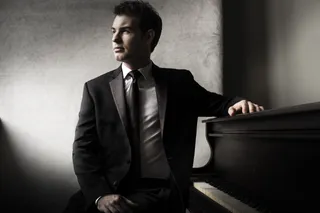
Beethoven & Schubert
Join us for an evening of classical brilliance with Beethoven's dramatic "Piano Concerto No. 3," featuring pianist Drew Petersen. The program also includes Schubert's majestic "Symphony No. 9, 'The Great'." Don't miss this captivating concert of orchestral masterworks.
Beethoven & Schubert
Saturday, February 22, 2025 at 7:30 pm
Beethoven: Piano Concerto No. 3
Drew Petersen, piano
Schubert: Symphony No. 9 “The Great”
Program Notes
Ludwig van Beethoven
Born on December 16, 1770, in Bonn, Germany
Died on March 26, 1827, in Vienna, Austria
Piano Concerto No. 3 in C minor, Op. 37
Ludwig van Beethoven's Piano Concerto No. 3 in C minor, Op. 37, stands as a pivotal work in the composer’s oeuvre, bridging the Classical and Romantic eras with profound innovation. Beethoven began working on the Third Piano Concerto in 1799, amid a period of significant personal and artistic growth. Major works he composed at this time include his Symphony No. 1 and the six string quartets that comprise his Op 18. Although he had already begun to establish his reputation as a formidable composer and pianist, the concerto marked a further departure from the Classical traditions epitomized by Mozart and Haydn, towards a more personal, expressive style that would characterize his later works.
His Second Piano Concerto, Op. 19, which was his first to be completed and performed, owes a considerable debt to the piano concertos of Mozart. It was completed in 1790 and likely received its premiere, with the composer as the soloist, in March of 1795, but this has not been firmly established. What is now regarded as his First Piano Concerto, Op. 15, also received its premiere in 1795, but shows greater maturity and character. The Third Piano Concerto was premiered on April 5, 1803, in Vienna, again with Beethoven himself as the soloist. This premiere was part of a massive concert that also featured the premieres of the Second Symphony and the oratorio "Christ on the Mount of Olives." The performance was reportedly somewhat under-rehearsed, and Beethoven had not fully completed the solo part in the score. As a result, he played much of the piano part from memory and improvised the cadenzas, a testament to his formidable pianistic skills and creativity. Despite these challenges, the concerto was well-received, although it initially took some time for audiences and critics to fully appreciate its innovations. Over time, it has become a staple of the piano concerto repertoire.
The concerto follows a standard structure of three movements. Of Beethoven’s five piano concertos, it is the only one in a minor key, C minor. This key, which is shared by his Fifth Symphony, imbues the piece with a darker, more dramatic character compared to his other concertos. Movement I., Allegro con brio, is in sonata-allegro form and is characterized by its bold and dramatic themes. The movement starts with a powerful orchestral introduction. When the piano finally enters, it does so with an unaccompanied statement that mirrors the orchestra's introduction, but adds a personal, introspective twist. This interplay between the piano and orchestra continues throughout the movement, highlighting the composer's skill in dialogic composition. Beethoven was renowned for his improvisational prowess. As mentioned prior, during the premiere of this work, he improvised the cadenzas. But unlike some that feel like separate entities inserted into the concerto, Beethoven’s written cadenzas are woven into the overall structure. They enhance the narrative flow, serving as climactic points that propel the music forward, rather than interrupting its progression. Yet, they still possess a quality that makes them feel improvised.
The second movement, Largo, provides a stark contrast to the first, offering a lyrical and introspective melody. This movement is set in the unexpected key of E major, a distant key from the tonic C minor, highlighting Beethoven's harmonic daring. The piano introduces a serene and expansive theme, accompanied by subtle orchestral textures. This movement provides a moment of introspective calm amid the concerto's overall drama. The final movement is a lively rondo, where the main theme (A) alternates with contrasting episodes (B, C, etc.). This structure allows Beethoven to explore various harmonic regions while maintaining a sense of unity. The movement is predominantly in C major, providing a bright and uplifting contrast to the overall minor tonality of the concerto. Yet, Beethoven employs playful and frequent modulations to keep the listener engaged. These modulations often shift to closely related keys, such as G major and A minor, but sometimes explore more distant harmonic regions. The work concludes with a spirited coda, bringing the concerto to a triumphant close. Beethoven uses powerful harmonic progressions to build excitement and drive toward the final resolution in C major. The Piano Concerto No. 3 is scored for solo piano, two flutes, two oboes, two clarinets, two bassoons, two horns, two trumpets, timpani and strings.
Franz Schubert
Born on January 31, 1797, in Vienna, Austria
Died on November 19, 1828, in Vienna, Austria
Symphony No. 9 “The Great” in C major, D. 944
When one considers that Franz Schubert died two months shy of his 32nd birthday, his compositional output of over 600 songs, six masses, fifteen string quartets, twenty-one piano sonatas and seven complete symphonies seems all the more remarkable. The bulk of this material was neither heard nor published during his lifetime either. For instance, none of his symphonies were published until after his death and there is still debate as to whether he heard any of them performed. During his lifetime, he was regarded primarily as a songwriter, not a symphonist. Schubert not only was a native Austrian, but he was also the only Vienna-born composer of all the great symphonists associated with the city, like Mozart, Beethoven, Bruckner, and Brahms. His first six symphonies owed a great deal to the Classical symphonic model of Mozart and Haydn, whose works he studied while still in his teens at the Imperial Seminary, or Stadtkonvikt, in Vienna. All of these early symphonies were completed between 1813 and 1818. After 1818, Schubert attempted several symphonies, but most, including his famous “Unfinished” Symphony in B minor, were abandoned in different states of completion. The only later symphony to see completion was the final “Great” C major symphony, D.944, by which time Schubert was as old as Beethoven was when he was writing his first symphony (the nickname “Great” is variously attributed to the work being a “grand symphony,” like Beethoven’s 3rd Symphony, as well as to distinguish it from Schubert’s earlier Symphony No. 6 in C major).
It was long believed that Schubert composed the work in his final year, but now it is thought he started on it in the summer of 1825 and completely orchestrated it by the following year. During the mid-1820s, Schubert began to develop recognition as a composer and was able to achieve a modicum of financial stability through the publishing of his songs. In 1818, he had unsuccessfully bid for admission to Vienna’s influential Gesellschaft der Musikfreunde or “The Society of Friends of Music” and this snub stunted his career. His publishers, though happy with the commercial prospects of his lieder, were as reluctant to pay much for them as they were to commission new works from him. Despite not having a commission for the piece or the expectation of a performance, Schubert started work on the symphony while vacationing in Upper Austria. 1825 was a rare stable period in Schubert’s life. Along with his struggles to gain recognition and support himself financially in the wake of his rejection by the Gesellschaft der Musikfreunde, he began to suffer from headaches in 1823 that were a symptom of the syphilis that is thought to have killed him (while it is nearly certain that Schubert had contracted syphilis, there is also the possibility that his final illness was typhus). From 1823 until his death, his health would be erratic, as was often the case with syphilis. Good periods and ill periods would alternate, though Schubert remained prolific through either. This happy period in Upper Austria can be heard in elements of the symphony, like the opening theme by the horn and the Ländler, an Austrian folk dance, evoked in the Trio. In October 1826, Schubert sent a copy of the completed work to the Gesellschaft der Musikfreunde, which responded by sending a small honorarium.
It was through the efforts of Robert Schumann that the symphony was rescued from obscurity and given its debut performance. In 1838, Ferdinand Schubert, the composer’s brother, received a visit from Schumann, who was visiting Vienna, and allowed the German composer access to his brother’s numerous unpublished manuscripts. Schumann realized the significance of his finding and sent the manuscript of the symphony to Felix Mendelssohn, conductor and music director of the Leipzig Gewandhaus orchestra. On March 21, 1839, Mendelssohn conducted the premiere performance of the work in Leipzig, over a decade after Schubert’s death. Schumann, in his capacity as editor of the music journal Neue Zeitschrift für Musik, praised the work with the phrase “heavenly lengths,” which has now become a famous description of the symphony’s epic scale.
The first movement, Andante - Allegro ma non troppo — Piu Moto, is reminiscent of Haydn’s “London” symphonies that start with a slow introduction before giving way to a quicker and more rhythmically vigorous movement. Here, the symphony opens with a stately theme by the horns, which is repeated by the woodwinds. The cellos counter with a lyrical variation. The first, grand theme is developed in a way that builds tension up slowly and patiently until it is released with the arrival of the Allegro ma non troppo section. Here, the tempo quickens, and the rhythm gains an energetic skipping quality, which is hinted at in the introduction. While Schubert introduces all new melodic themes for this section, in the triumphant coda that closes the movement, the stately horn theme returns, now played by the entire orchestra.
The second movement, Andante con moto, is in the relative key of A minor. Rather than giving us a conventional slow movement, Schubert instead has this one proceed with a march-like air that builds to a massive fortississimo climax. Woodwinds are featured throughout the movement from its beginning with a solo for oboe.
The third movement, Scherzo: Allegro vivace; Trio, is in the meter of 3/4 and follows the sonata form. Like most scherzi, the rhythms are robust. The Trio section of the movement provides a contrast by modulating to A major from the C major of the Scherzo and by adopting the gentler rhythmic lilt of the Austrian Ländler, which Schubert used in other works.
he final movement, Finale: Allegro vivace, shares the same energetic rhythms of the earlier movements and builds upon them. The music releases like a racehorse from a starting gate. It is as if after all the false starts of his incomplete symphonic fragments Schubert’s muse removed the block and the music rushed forth, complete and logical. The finale, like the entire symphony, is of massive length for
its time, yet Schubert’s writing is so balanced and full of contrasts that there is no slack.
Schubert scored the symphony for two flutes, two oboes, two clarinets, two bassoons, two horns, two trumpets, three trombones, timpani, and strings.
©Symphony in C program notes are written by Eric Polack and Joseph C
Schiavo.